

Written by : Manjeet Sehgal | Date: March 2, 2026 | Time: 1:45 AM | Location: New Delhi, India
The world stands on the precipice of a global catastrophe as the US-Israel joint strikes on Iran reach a critical tipping point. Following the launch of Operation Epic Fury on February 28, 2026, coordinated airstrikes have decapitated Iran’s top political and military leadership. As of today, March 2, fresh Israeli strikes continue to target central Tehran. Simultaneously, global markets are bracing for a historic supply shock. This analysis explores the immediate military fallout and the long-term economic ripple effects. These factors now threaten to tip the global economy into a deep recession.
Operation Epic Fury: The Fall of Tehran’s Leadership
The military campaign began with a massive wave of B-2 stealth bombers. These aircraft targeted ballistic missile sites and naval installations across Iran. Codenamed Operation Epic Fury by the US and Roaring Lion by Israel, the mission aims to dismantle Iran’s nuclear program entirely. Consequently, a high-precision strike on a fortified compound in Tehran resulted in the death of Supreme Leader Ayatollah Ali Khamenei. Reports confirm that 48 other senior officials also died in the attack.
President Trump recently described the ongoing operations as “ahead of schedule” during a late-night press briefing. However, the human cost is mounting rapidly across the region. Current reports cite at least 201 dead and over 747 injured within Iran. Furthermore, a strike near a civilian school in a residential district has drawn sharp international condemnation from the United Nations.
Iran’s Retaliation and Regional Escalation
In a desperate counter-offensive, Iran launched hundreds of ballistic missiles and “suicide” drones. These weapons targeted Israeli population centers, killing nine people and injuring 121 others. Most of these casualties occurred in Haifa and Tel Aviv. Simultaneously, Iranian proxy forces targeted US military bases across the Gulf states. These strikes hit facilities in Bahrain, Kuwait, Qatar, and the UAE.
US Casualties: Three service members confirmed killed in regional strikes.
Proxy Activation: Hezbollah and Houthi rebels are on high alert.
Regional Stability: Strikes threaten the security of Saudi Arabia and neutral Gulf nations.
Therefore, the risk of a wider regional war is no longer a theory. It has become a present reality. This activation directly threatens the stability of the entire Middle East.
Oil Prices and the Strait of Hormuz Crisis
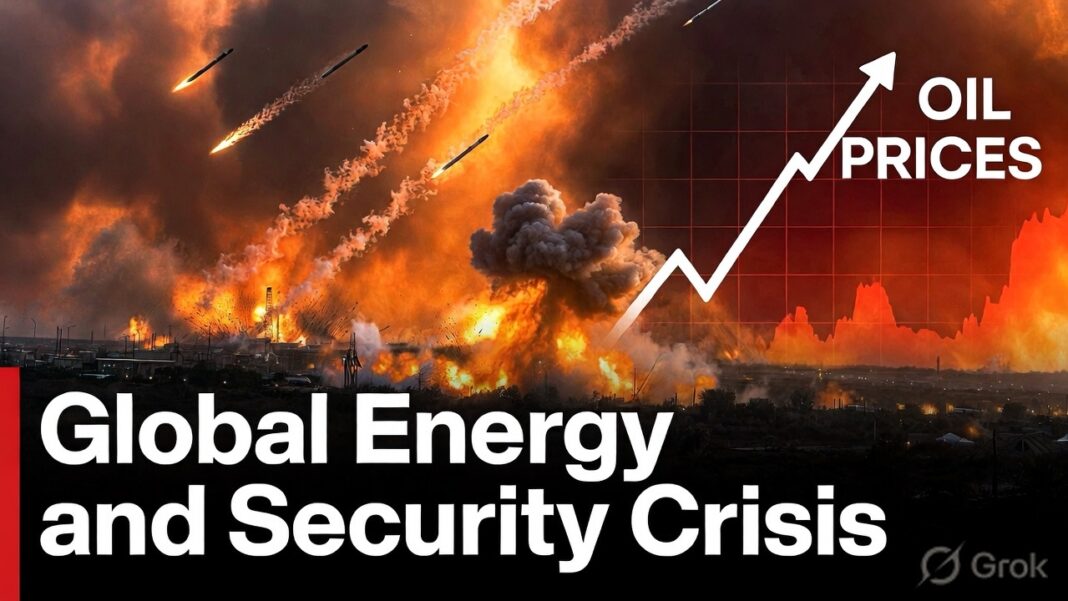
The most immediate threat to the global public is the potential closure of the Strait of Hormuz. Because Iran controls this narrow waterway, 20% of the world’s oil trade is now in jeopardy. Any Iranian attempt to deploy sea mines or anti-ship missiles could spike Brent crude prices instantly.
Financial analysts predict that oil could jump from $75 to well over $100 per barrel within days. A prolonged closure would lead to a global energy crisis. For instance, even a short disruption could add $10-$20 to the price of a barrel immediately. This surge would inevitably lead to a global recession if shipping routes remain blocked for several weeks.
Inflation and Global Economic Ripple Effects
Higher oil prices always lead to surging gasoline and fuel costs worldwide. This conflict will likely add 0.6% to 0.7% to global inflation in the coming months. Manufacturing, transport, and food production costs will rise as a direct result of the US-Israel joint strikes on Iran.
Asia: China, Iran’s top oil buyer, faces a massive energy deficit.
Europe: Fragile economies may see their recovery efforts erased.
Markets: Stock markets expect sharp drops, while gold and safe-haven assets will surge.
Conclusion: A World in Waiting
The situation remains fast-moving and unpredictable. President Trump has signaled an openness to talks but continues to threaten “force never seen before.” The ultimate impact of these strikes will depend on two factors. These are the continued openness of the Strait of Hormuz and the scale of the Iranian domestic collapse. For now, the world watches the Middle East with bated breath. Many fear that the 2026 conflict has only just begun.
Journalist Note: This analysis was compiled using field reports and diplomatic cables. As reported by Manjeet Sehgal , intelligence suggests the vacuum created by the Supreme Leader’s death may lead to a protracted civil struggle within Iran.