
-
40th anniversary honors 329 Kanishka victims.
-
Khalistani terrorists orchestrated deadly attack.
-
Canadian authorities ignored critical warnings.
-
Investigation failures shielded perpetrators.
-
Canada remains a Khalistani haven.
On June 23, 2025, global leaders honored 329 victims of the Air India Kanishka bombing in Cork, Ireland, marking its 40th anniversary. Ideologies may differ, but humanity must combat terrorism unitedly. Ireland’s Prime Minister Michael Martin, Canada’s Minister Gary Anant, and Indian leaders, including Tarun Chugh, Narinder Raina, Arvinder Lovely, Baldev Aulakh, Gurveer Brar, and Trilok Kaur Cheema, paid tributes. They stressed halting terrorist funding to curb extremism. The tragedy must never recur.
The 1985 bombing remains a grim milestone. Air India Flight 182 exploded mid-air, killing all aboard. Most victims were Canadian-Indians. Leaders vowed to prevent such atrocities.
The event highlighted Canada’s shortcomings in the justice system.
The commemoration renewed demands for accountability. Canada’s inaction remains contentious. Families seek closure. The tragedy exposed systemic flaws. Global unity against terrorism is urgent.
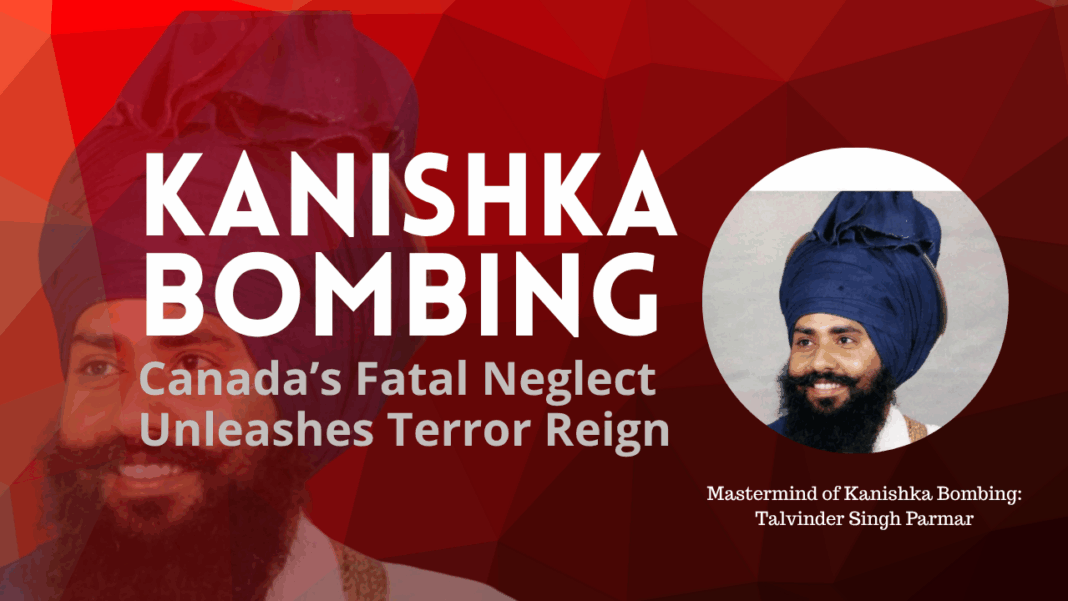
Khalistani groups like Babbar Khalsa executed the attack. Talwinder Singh Parmar led the plot. Inderjit Singh Reyat, the only convicted, served minimal time. He was freed in 2017. Ripudaman Singh Malik and Ajaib Singh Bagri walked free in 2005.
Canada’s justice system has disappointed the families of victims. “The light sentences shocked us,” said victim relative Bal Gupta (CBC News, 2010). Many believe political pressures spared the culprits. The lack of convictions fueled distrust. Khalistani networks continued to operate. Canada’s leniency raised global concerns.
The minimal accountability frustrated justice efforts. Victims’ families felt betrayed. Canada’s response drew international criticism. The case remains a painful reminder. Stronger measures are needed.
Canadian authorities’ negligence enabled the tragedy. Months before, Gerry Boudreault warned that Parmar offered $200,000 to bomb an Air India plane. His tip was ignored. Harmail Singh Grewal informed CSIS and RCMP about a similar plot. They dismissed him as unreliable after a failed deal.
In June 1985, RCMP informant Paul Besso recorded talks of an Air India attack. The RCMP overlooked these transcripts. Gurmej Singh Gill, a leader of the Babbar Khalsa, threatened passengers of Air India. Authorities neither confirmed nor refuted this. Before June 9, Parmar warned a Toronto Gurudwara against flying Air India. This was ignored.
These missed warnings led to disaster. A Tokyo airport bomb killed two baggage handlers. An hour later, Flight 182 disintegrated off Ireland’s coast. “Canada’s inaction was devastating,” said diplomat Vikas Swarup (Hindustan Times, 2018). The negligence remains a sore point.
The authorities’ inaction shocks observers. Timely action could have averted disaster. Canada’s failures fueled global outrage. The tragedy highlights the importance of vigilance.
Accountability remains elusive.
The Royal Canadian Mounted Police (RCMP) faced intense scrutiny. They mishandled evidence and failed to protect witnesses. Key leads were ignored. Was this carelessness or intentional? The 1980s witnessed a surge in Khalistani activism in Canada. Authorities underestimated the threat.
Some suspect political motives shielded Khalistani groups. Canada’s liberal policies allowed extremist activities. The RCMP later admitted errors. In 2010, Canada apologized for lapses in its investigation. Yet, doubts about deliberate protection persist. Indian officials criticized Canada’s inaction.
“The investigation was flawed from the start,” noted security expert John Major (Globe and Mail, 2010). The lack of convictions left wounds unhealed. Families still seek justice. The case exposed systemic gaps. Canada’s response remains under scrutiny.
The investigation’s failures frustrated global efforts. Critical evidence was lost. The tragedy demands stronger oversight. Canada must address these lapses. Justice delayed is justice denied.
Canada’s Role as a Safe Haven for Khalistani Extremists
Canada’s lenient policies enabled Khalistani terrorists to flourish. Liberal laws protected extremist activities. Khalistani groups raised funds openly. They held rallies unchecked. India repeatedly raised alarms.
Post-1985, Canada became a separatism hub. Khalistani leaders operated freely. The Kanishka case exposed this issue. Canada’s inaction strained India-Canada ties. “Canada must act decisively,” urged Swarup (Hindustan Times, 2018). Tensions continue today.