
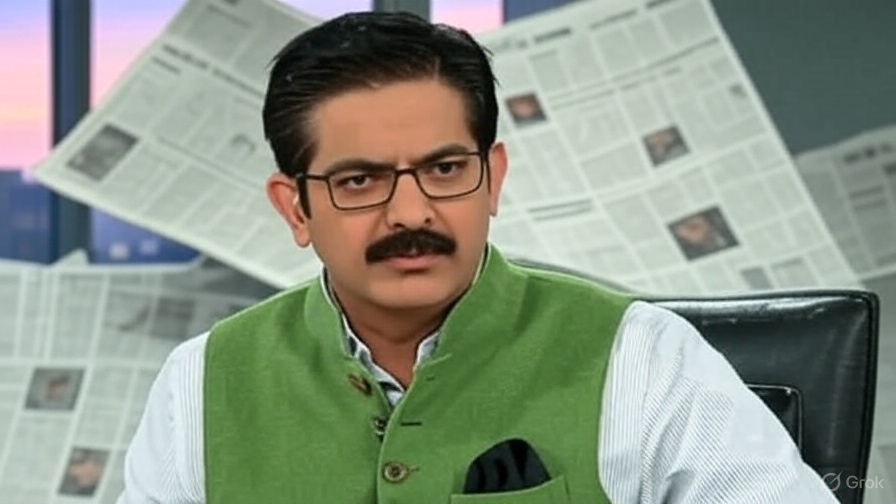

Pointers :
• Veteran journalist Sumit Awasthi exposes the media’s financial dependence on government ads.
• Government advertisements account for 70-80% of news channels’ revenue.
• Ruling party’s budget dominance pressures media to avoid critical coverage.
• Print media also relies heavily on government ad funding.
• Financial leverage threatens editorial independence across Indian media.
• Veteran journalist Sumit Awasthi exposes the media’s financial dependence on government ads.
• Government advertisements account for 70-80% of news channels’ revenue.
• Ruling party’s budget dominance pressures media to avoid critical coverage.
• Print media also relies heavily on government ad funding.
• Financial leverage threatens editorial independence across Indian media.
A veteran journalist, Sumit Awasthi, has revealed a disturbing truth about the state of Indian media, highlighting how government advertisements suppress independent journalism. “We’re called ‘Godi Media’ because we don’t show anything against the government. I’m speaking honestly,” Awasthi stated. He explained that television channels and newspapers rely on government ads, which account for 70-80% of their revenue. “TV channels still run on advertisements. Of every 100 rupees earned through ads, 70-80 rupees come from government advertisements,” he added.
This financial dependence creates a system where media outlets face intense pressure to align with the ruling party’s narrative. Awasthi noted, “The ruling party has the biggest budget. Where will the opposition get such funds?” If media houses criticize the government, their ads are often withdrawn—a tactic Awasthi calls “arm-twisting.” This applies to both TV channels and newspapers, stifling their ability to report objectively.
Recent data underscores this issue. Network18’s news business reported ₹430 crore in revenue for Q1 2025, with government ads forming a significant portion. This reliance raises serious questions about media impartiality in India’s democracy.
Financial Dependency Threatens Press Freedom
The influence of government ads extends to print media, further eroding press freedom. Reports indicate that the YSRCP government spent ₹859 crore on newspaper advertisements over five years, with major dailies such as Sakshi (₹293 crore) and Eenadu (₹190 crore) receiving substantial shares. Central government ad spending on print and TV fell from ₹898.51 crore in 2014-15 to ₹168.80 crore in 2022-23, yet its impact remains strong.
Awasthi emphasized that advertisements are the primary revenue source for news channels, supplemented by subscriptions. However, with 70-80% of ad revenue coming from government sources, media houses often self-censor to secure funding. “If we show anything against them, they stop their advertisements. This arm-twisting happens with both newspapers and TV channels,” he said.
The term “Godi Media,” meaning “lapdog media,” has gained traction to criticize outlets prioritizing government interests over journalistic integrity. As financial pressures mount, the public questions whether India’s newsrooms can break free from this control to deliver unfiltered truth.
Can Indian Media Regain Its Independence?
The growing debate over media ethics has left many wondering if India’s press can reclaim its independence. Awasthi’s revelations highlight a systemic issue where economic pressures threaten the democratic principle of a free press. Critics argue that the ruling party’s financial leverage allows it to dominate media narratives, effectively silencing dissent and critical coverage.
In recent years, the term “Godi Media” has become a popular critique of media groups seen as overly aligned with the government, often at the expense of unbiased reporting. With government ads forming the backbone of media revenue, outlets face a stark choice: comply or lose funding. This dynamic undermines the media’s role as a watchdog in India’s democracy.
As discussions on media freedom intensify, the public is left grappling with a critical question: Can India’s newsrooms overcome the financial grip of those in power to report the truth without censorship?
Who is Sumit Awasthi
Sumit Awasthi is a renowned Indian journalist and news anchor, widely recognized for his impactful contributions to Hindi journalism. Born on April 23, 1973, in Gautam Buddh Nagar, Uttar Pradesh, he comes from a family with deep journalistic roots, as his father, Suresh Awasthi, worked with All India Radio (Akashvani) and Bhartiya Suchna Sewa.
Initially aspiring to join the Indian Army, Sumit attempted the selection process twice but ultimately turned to journalism after completing his postgraduate studies.
His career began with an internship at Jansatta, followed by a significant stint at Zee News in 1997. Over time, he collaborated with top channels such as Aaj Tak and IBN 7. Currently, he serves as Consulting Editor at NDTV India and hosts the 8 PM show.
Known for his sharp political reporting and engaging anchoring, Sumit has hosted popular shows like “Shabaash India” and appeared as an expert on “Kaun Banega Crorepati.” He has been honored with awards such as the Madhavji Jyoti Puraskar in 2012 and the Dadasaheb Phalke Excellence Awards in 2019.
Recently, he has voiced concerns about media ethics, critiquing the influence of government advertisements and labeling some channels as “Godi Media.” At 52, his energetic presence and commitment to unbiased reporting continue to shape India’s media landscape, establishing him as a respected figure in the industry.