

Key Points:
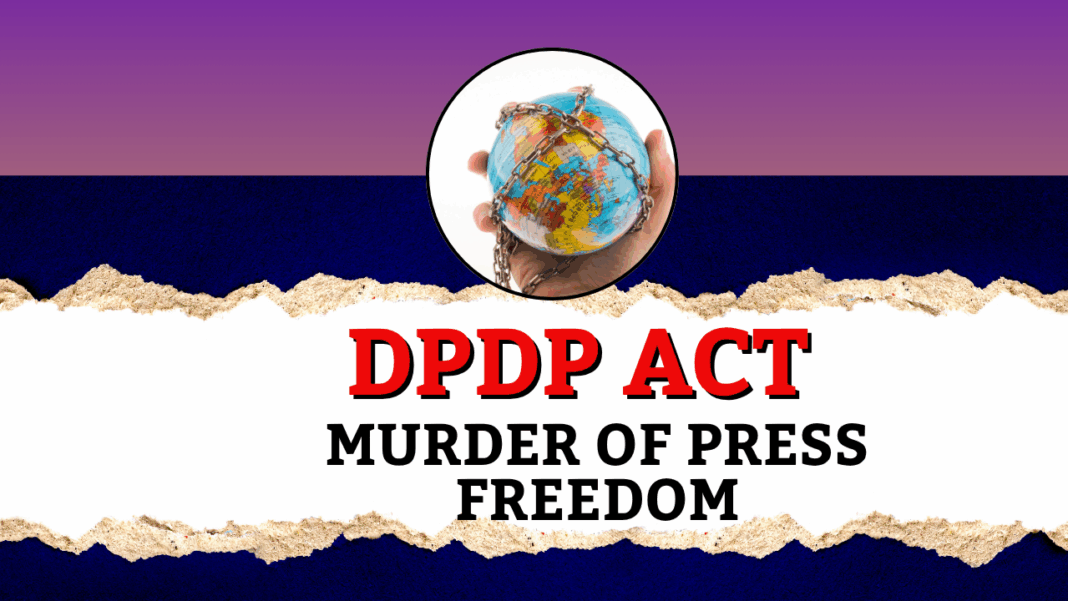
- The Digital Personal Data Protection (DPDP) Act 2023 will pose a threat to media freedom.
- This law also includes journalism, which will hinder investigative reporting.
- Consent rules will make it difficult to expose corruption.
- The Right to Information (RTI) Act has also been weakened due to this law.
- Now, obtaining and using public information is also risky.
Indian journalist organizations are demanding amendments to the DPDP law.
The Government of India is set to introduce the Digital Personal Data Protection (DPDP) Act 2023, aiming to protect personal data. However, the enactment of this law is poised to endanger the freedom of the Indian media, unlike global regulations such as the GDPR, which exempt journalistic work, the DPDP Act will require journalists to obtain consent before publishing anyone’s personal information. This condition will make it challenging to expose corrupt politicians and officials, as news against them cannot be published without their permission.
Violating this law could result in a fine of up to ₹500 crore, which is enough to bankrupt even large media houses. These conditions will promote self-censorship in the country. Sangeeta Barooah of the Press Club of India states that the DPDP law will pose an existential threat to independent journalism because it will, in some form, curb media rights and freedom.
The DPDP Act does not provide any exemptions for journalists. Investigative journalism often relies on personal data to expose scams or misconduct. For example, if there is fraud in Bihar’s voter list and a journalist wants to reveal it, obtaining consent from millions of people would be necessary. Such a condition and demand would be impractical.
According to the Press Club of India, the vague definitions in the DPDP Act enable the government to determine what data is public, thereby further limiting media access.
The Press Club of India, along with 22 media bodies, submitted a memorandum to Union Minister Ashwini Vaishnaw on June 24, 2025, demanding clarity and exemptions for journalists in the DPDP law.
RTI Act Weakened Due to DPDP
The DPDP Act also proposes amendments to the Right to Information Act, which exempts all personal information from disclosure. Through the RTI Act, journalists can easily access public records; however, attempts are now being made to restrict this access.
For example, if one wanted to know the names of bank loan defaulters through RTI, their names can no longer be disclosed because the RTI Act is being brought under the purview of the DPDP Act through amendments.
Advocate Anjali Bhardwaj has stated that due to the DPDP law, the public’s right to know, i.e., RTI, is now at risk.
According to Anjali Bhardwaj, 60 lakh people utilize the RTI Act annually, making it a crucial tool for government accountability. However, through the DPDP, the government will now be able to conceal misconduct, as there will be no transparency.
Notably, journalists rely on RTI to uncover corruption, environmental violations, or human rights abuses. Following the amendment to the RTI Act, only government-approved information will be made available to the public. This means the government will present information by hiding and twisting the truth wherever it wishes. This opacity will endanger democracy.
Attempt to Intimidate Investigative Journalists and Whistleblowers
Investigative journalism, which exposes influential figures, faces existential threats under the DPDP Act. The consent requirements prevent journalists from naming individuals in cases involving corruption or human rights violations. Nitin Sethi of The Reporter’s Collective says, “This law could kill investigative reporting.” Exposés like the Electoral Bonds, which revealed the corporate-political nexus, relied on personal data. Such reporting may become impossible, as sources fear legal repercussions. Whistleblowers, crucial for exposing scams, may also remain silent due to the penalties imposed by the Act.
The Act’s financial penalties, ranging from ₹250 crore to ₹500 crore, create a climate of fear and intimidation. Small media outlets, already struggling, cannot afford such fines. This could lead to a media landscape dominated by compliant outlets, reducing diversity and public discourse. Section 36 of the Act, which allows authorities to demand journalists’ sources, further erodes press freedom, enabling government overreach.
DPDP Law Will Promote the Suppression of Journalism
India’s media face growing threats, ranking 151 out of 180 in the World Press Freedom Index. Journalists endure physical attacks, legal cases, and website blocks. The DPDP Act adds a new weapon for suppression. Apar Gupta of the Internet Freedom Foundation says, “The government’s control over data rules is alarming.” Recent incidents, such as the blocking of 2,300 X (formerly Twitter) accounts, including Reuters, demonstrate arbitrary censorship.
Independent outlets, such as The Wire, face similar attacks, limiting their reach.
The Act’s discretionary powers allow the government to exempt certain entities, potentially favoring pro-government media. This creates an uneven playing field, where critical voices face harsher scrutiny. The Press Club of India reports that it issues five to six monthly press releases addressing journalist attacks, highlighting the crisis. Small-town reporters, covering local corruption, bear the brunt of legal and physical intimidation, further silencing grassroots journalism.




 Act 2023, aiming to protect personal data.)