
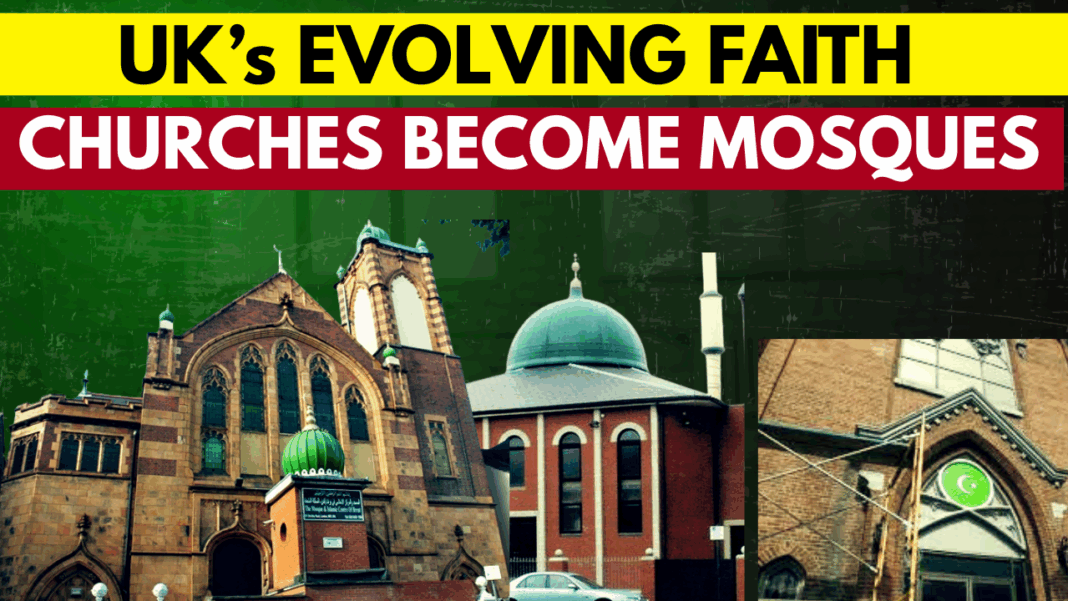

Pointers :
-
Declining church attendance drives closures, with many sold for new uses.
-
Muslim communities convert churches into mosques to meet worship needs.
-
Recent conversions include Clayton Heights in Bradford and a church in Stoke-on-Trent.
-
Legal and heritage concerns, such as covenants, sometimes hinder conversions.
-
No centralized data comprehensively tracks the number of UK churchgoers converting to mosques.
The UK’s religious landscape is undergoing a transformation as church attendance declines sharply. Over 3,500 churches have closed in the past decade, with the National Churches Trust reporting 2,000 closures due to low congregations and high maintenance costs. Many of these historic buildings, some of which are centuries old, are being sold to serve new community purposes.
Growing Muslim populations, driven by migration and higher birth rates, are repurposing some into mosques. For example, Clayton Heights Methodist Church in Bradford, vacant since 2020, was bought by the local Muslim community in 2024 for conversion into a mosque.
Similarly, a derelict Grade II* listed church in Stoke-on-Trent received city council approval in 2024 to be converted into a mosque and community center. “Churches must adapt to modern needs,” says Claire Walker of the National Churches Trust. These shifts highlight the practical reuse of Christian heritage but spark debates about its preservation.
Converted Churches Blend Christian Architecture with Islamic Features
Repurposed churches often retain Christian elements while incorporating Islamic features, such as mihrabs and minbars, thereby blending the two traditions. In Bradford, Clayton Heights Methodist Church, dating to 1870, is undergoing renovations to serve as a mosque, combining its historic structure with Islamic design.
Repurposed churches often retain Christian elements while incorporating Islamic features, such as mihrabs and minbars, thereby blending the two traditions. In Bradford, Clayton Heights Methodist Church, dating to 1870, is undergoing renovations to serve as a mosque, combining its historic structure with Islamic design.
In London, St. Mark’s Church in Camberwell, now a mosque, preserves its Gothic arches and stained-glass windows, which depict Jesus. The Brick Lane Mosque, originally a Huguenot chapel, now serves as a place of worship for Sufi worshippers.
A Cricklewood church, adapted with an onion-shaped dome, reflects this fusion. “We’re reusing spaces, not erasing their history,” says Imam Ali of Al Emaan Keston Mosque, converted in 2016. An X post from August 2024 noted the removal of a cross from a church in Northwest London, raising heritage concerns. These conversions, such as the Hagia Sophia’s shift from church to mosque in Istanbul, demonstrate how sacred spaces evolve, striking a balance between tradition and modern needs.
Public Reactions Range from Pragmatism to Heritage Concerns
Church-to-mosque conversions elicit varied responses, especially on X. Some posts, like one about Masjid-e-Taqwa in Blackburn, label conversions “Islamification,” expressing unease over lost Christian identity.
Church-to-mosque conversions elicit varied responses, especially on X. Some posts, like one about Masjid-e-Taqwa in Blackburn, label conversions “Islamification,” expressing unease over lost Christian identity.
Others view them as practical, noting that derelict churches would otherwise decay and deteriorate. A 2013 petition opposing conversions gained only three signatures, indicating limited widespread resistance. However, local controversies have arisen, such as the unauthorized removal of a Bristol church’s headstone around 2014.
Legal barriers also emerge, as seen with St John’s Church in Hanley, where a 2024 conversion was halted by a covenant restricting non-Christian worship. “Heritage and community needs both matter,” says historian Dr. Sarah Jones. Recent cases, like Clayton Heights and Stoke-on-Trent, highlight how conversions symbolize cultural shifts while fueling debates about tradition in a multicultural UK.
Tracking Conversions Faces Challenges Due to Data Gaps
No centralized database tracks church-to-mosque conversions, making it hard to quantify the trend. While dozens are reported, including cases in Clayton Heights, Bradford, and recent incidents in Lancaster and Bradford from January 2024, X posts often lack specifics.
No centralized database tracks church-to-mosque conversions, making it hard to quantify the trend. While dozens are reported, including cases in Clayton Heights, Bradford, and recent incidents in Lancaster and Bradford from January 2024, X posts often lack specifics.
The Church of England and local councils maintain partial records, but access to them is limited. Estimates suggest that a small fraction of the 20,000 sold churches are converted into mosques, while others are repurposed as homes or cafes.
“Better data is needed to understand this change,” says researcher Mark Taylor. Historical examples, such as the conversion of a Bermuda church by the Nation of Islam and its later transformation into a Sunni mosque, demonstrate that this is a global phenomenon. Local records or planning permissions could clarify the scope, but targeted research is required to bridge these gaps and document the UK’s evolving sacred spaces.