

Key Points:
- Ankura Hospital performed India’s first colonoscopic cecostomy for Spina Bifida.
- The procedure enabled a 32-year-old woman to manage bowel evacuation independently.
- A PEG tube was used without surgery, ensuring minimal invasiveness.
- The patient was discharged within 24 hours without pain medication.
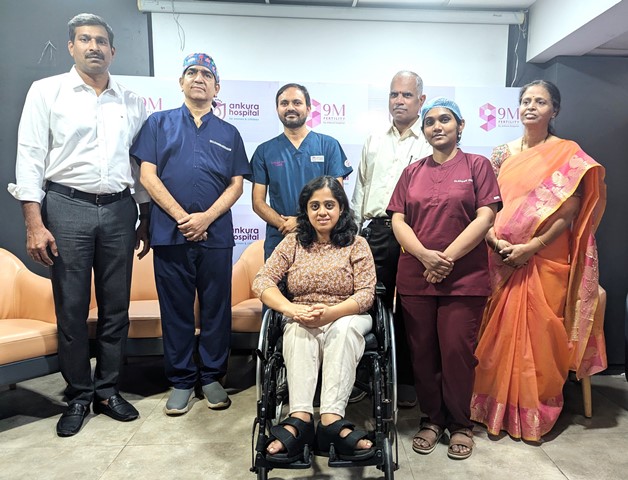
Hyderabad: Ankura Hospital in Banjara Hills achieved a groundbreaking milestone in neurogastroenterology by performing India’s first colonoscopic cecostomy on a 32-year-old woman with Spina Bifida. This innovative procedure restored her independence, allowing self-managed bowel evacuation. Led by Dr. VVS Chandrasekharam and Dr. Parijat Ram Tripathi, the minimally invasive technique used a PEG tube, eliminating the need for incisions and enhancing the patient’s quality of life.
Historic Milestone: India’s First Minimally Invasive Procedure for Spina Bifida
Ankura Hospital in Banjara Hills performed a revolutionary surgery on a 32-year-old woman with Spina Bifida, a condition causing bowel and bladder dysfunction since birth. Dependent on her parents for manual enemas, she had faced challenges after a failed surgery a decade ago. Dr. VVS Chandrasekharam, Chief Surgeon, devised a solution. His team proposed a colonoscopic cecostomy, a first in India.
Using a PEG tube inserted into the cecum, the procedure avoided traditional surgery. The patient can now manage her bowel movements independently. Dr. Parijat Ram Tripathi said, “This was a complex case.” Past surgeries had created complications, but the team succeeded. The patient expressed joy, saying, “I feel free now.” This procedure offers hope to others. It highlights Ankura’s commitment to innovation. The hospital’s efforts have inspired the medical community.
Technical Excellence and Success of Colonoscopic Cecostomy
The colonoscopic cecostomy involved inserting a 14 Fr PEG tube into the cecum using colonoscopic guidance. No incisions were needed. Dr. Tripathi noted that the patient’s prior surgeries made the procedure more challenging.
The team studied medical literature thoroughly. Careful planning ensured success. Within 24 hours, a saline flush enabled spontaneous bowel movement. The patient felt no pain. No medication was required. She was discharged the next day, satisfied. Dr. Chandrasekharam said, “This transforms lives.” The technique benefits patients with neurological disorders. The operating theater team played a key role. This success sets a new standard. Other patients can now hope for similar outcomes. Ankura’s expertise shone through. The procedure is a medical breakthrough. It will inspire further advancements. The hospital’s reputation grew stronger.
Ankura Hospital’s Commitment to Innovation and Patient Care
Ankura Hospital solidified its reputation with this procedure. It leads in pediatric and women’s care. Dr. Krishna Prasad Vunnam said, “We blend compassion with innovation.” This surgery exemplifies that approach. Ankura’s expert team handles complex cases. The procedure marked a milestone in neurogastroenterology.
It restored the patient’s independence. This inspires other hospitals. A family member said, “This gives hope.” Ankura demonstrated technical excellence. It strengthens pediatric care in India. The hospital plans more innovations. This procedure will benefit others. Local communities praised Ankura’s efforts. The hospital’s focus on personalized care stands out. It sets a benchmark for medical excellence. Ankura continues to transform lives.
New Hope for Spina Bifida Patients in the Future
This surgery brings new possibilities for Spina Bifida patients. The minimally invasive approach offers a practical solution. It reduces dependency on caregivers. Patients can lead independent lives. This procedure sets a precedent. Dr. Tripathi believes it will help many. Ankura plans to train other doctors. This will spread the technique. The hospital’s success sparked discussions. Medical forums now focus on similar innovations.
A local doctor said, “This is a game-changer.” Patients feel empowered. The procedure improves quality of life. Ankura’s work inspires hope. It encourages research in neurogastroenterology. This milestone will shape future treatments. Spina Bifida patients have new opportunities.