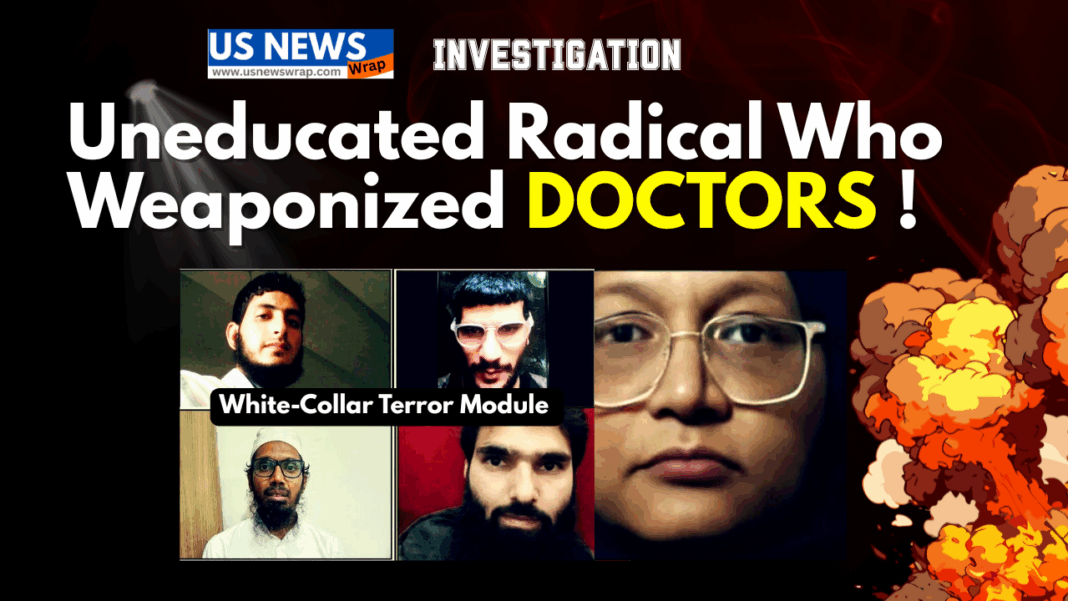

Imagine respected doctors—highly educated professionals sworn to save lives—secretly plotting terrorism. This shocking duality is at the heart of the sprawling investigation where a major White-Collar Terror Module Busted operation exposed a terrifying network. The unlikely mastermind? Not a veteran militant, but Moulvi Mohammad Irfan, a cleric who never finished third grade.
How did a primary school dropout successfully radicalize specialists holding prestigious degrees? The story begins with a brazen JeM poster campaign on October 17th. When forces captured Irfan, the trail led directly to Al-Falah University in Faridabad.
Crucially, investigators discovered a sinister convergence there. Four Kashmiri doctors, including professors, were actively using the campus as a covert meeting hub. This influential terror cell operated under the guise of intellectual authority. Furthermore, the university itself is under scrutiny for financial irregularities, including receiving ₹11 crore in international funding from Turkey and Germany. This case is a terrifying look at how extremism infiltrated professional institutions, turning healing hands into instruments of terror.
The Unlikely Mastermind Behind the Radicalization
The investigation into the White-Collar Terror Module Busted began with the arrest of a cleric in Shopian, Kashmir. This startling discovery revealed a low-educated man successfully radicalizing highly respected doctors. Moulvi Mohammad Irfan, a resident of Shopian, was the lynchpin. He had only studied up to Class Three. Irfan’s exposure uncovered a chilling, sophisticated plot orchestrated by a new ‘White-Collar Terror Module.’ Despite his minimal schooling, Irfan possessed a potent capability for propagating extremist ideology. He taught at a Madrasa in Nowgam.
On October 17, Irfan personally authored a clearly threatening poster. He wrote it on behalf of the terror outfit Jaish-e-Mohammad (JeM). Furthermore, the poster was filled with highly provocative messages targeting the Indian Army. Security forces quickly spotted the flyer and launched a targeted search. Consequently, the investigation led them directly to Moulvi Irfan. Jawans swiftly reached Shopian and arrested him the very next day. They recovered more incendiary posters from his mosque room. This initial capture proved crucial in cracking the entire module.
The Poster Campaign and the Doctors’ Capture
Even after Irfan’s arrest, the situation flared up again. The calm was broken on October 27. Similar printed posters reappeared in Nowgam. CCTV footage was instrumental in identifying the culprit. The poster placer was Dr. Adeel Mohammad of Vipoora, Kulgam. Dr. Adeel, unaware of the Moulvi’s capture, put up the posters. Therefore, he stayed at his home for three days afterward.
The sequence of events leading to the bust was rapid:
October 31: Dr. Adeel flew to Delhi. He met two doctor colleagues, Muzzammil and Umar, and spent the night with them.
November 1: He arrived at his hospital in Saharanpur, Uttar Pradesh.
The agencies were now certain they dealt with a dangerous, educated White-Collar Terror Module. They launched a meticulous, simultaneous operation. One team went to Saharanpur, and the other went to Dr. Adeel’s residence in Kulgam. On November 4, Dr. Adeel was eating at a Saharanpur restaurant when he heard of the police presence at his Kulgam home. He attempted to flee, but the investigation team waiting outside successfully apprehended him.
Following three days of rigorous interrogation, Dr. Adeel exposed the identities of the module’s central figures. These individuals were all his university colleagues, including Dr. Muzzammil, Dr. Natho, and Dr. Shaheen Saeed. Based on this critical intelligence, authorities arrested his two main associates in Faridabad on November 9. However, a third member, Umar, managed to escape but remained under constant surveillance.
🏛️ Al-Falah University: The Plotting Hub
The most concerning aspect of the case is the discovery that four terrorist doctors originated from Al-Falah University. This institution is located in Bhoj village, Faridabad. Internal reports reveal a shocking detail: 40% of the doctors employed there are Kashmiri. The management attributes this high concentration to economics. These doctors are simply available at lower salaries compared to professionals from other states. Therefore, the university prioritizes their recruitment.
A female doctor at the college, speaking anonymously, provided crucial insight into the conspiracies within the campus. Dr. Shaheen Saeed joined as a professor in 2021. She served on key college committees. Consequently, she recruited three other doctors from Pulwama in 2022: Muzzammil Shakeel, Mohammad Nathi Umar, and Sajjad Ahmed. Sajjad was made a member of the College Committee. This granted both Shaheen and Sajjad significant influence over university affairs.
Furthermore, Room Number 13 in University Building No. 17 was identified as the center of the terror planning. Key figures like Muzzammil, Umar, and Sajjad would gather there after 8:00 PM for covert discussions. Finally, a high-profile link was noted. Professor Dr. Nisar-ul-Haman was dismissed by the J&K Lieutenant Governor in 2023 for a ‘terror link.’ Yet, he subsequently secured employment at Al-Falah University. This clearly indicates that the institution is now under intense scrutiny by central investigation agencies.
Foreign Funding and the ED’s Audit
The investigation also uncovered evidence of international financial links. The university received ₹11 crore in funding from Turkey and Germany. Moreover, the university purchased land for Madrassas in Punjab and Amroha.
The Central Government has now mandated the Enforcement Directorate (ED) to conduct a forensic audit of the university’s bank accounts. The ED team is scheduled to arrive soon. They will meticulously trace the source and extent of all funding received by the university. A staff member confirmed that delegations from Arab countries visited the university annually. This suggests strong connections between the Kashmiri doctors and potential funding channels in the Gulf region. These links will be a key focus of the financial probe.